
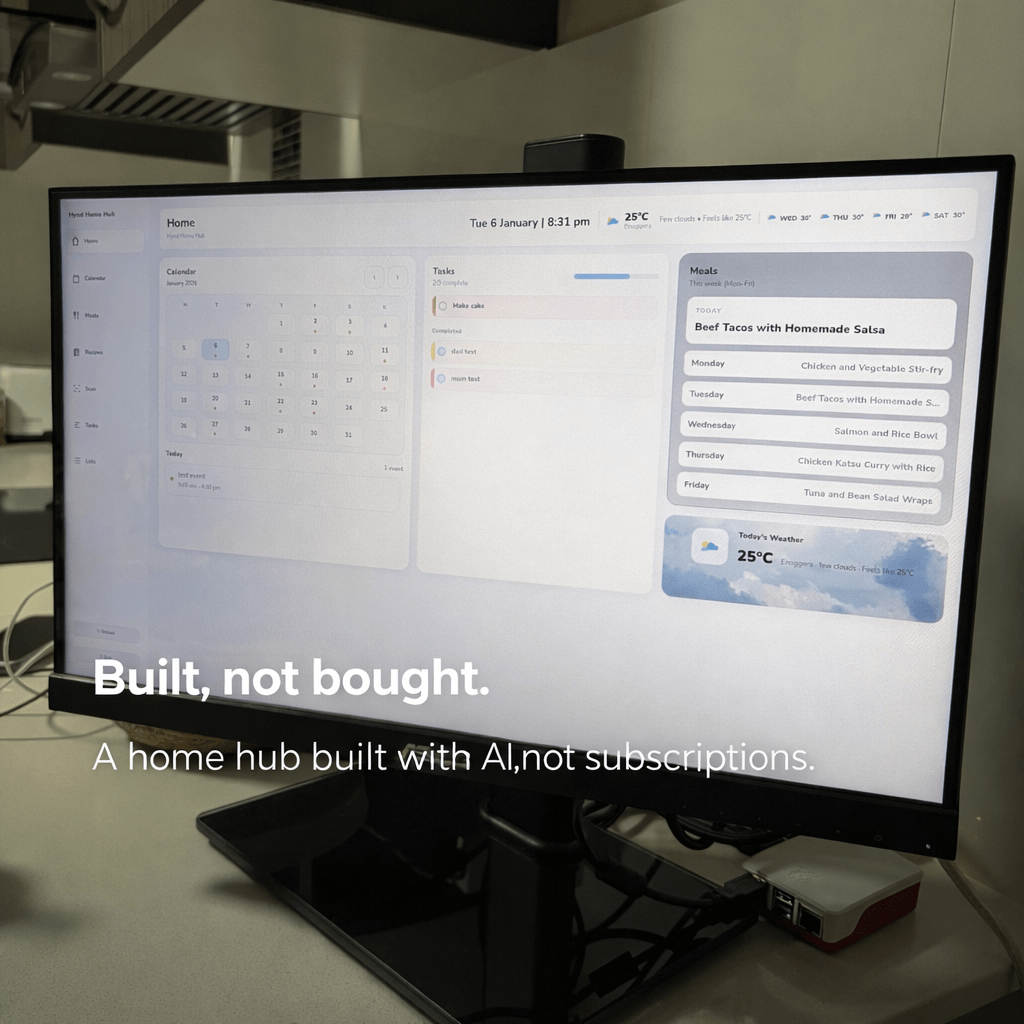
I Built a Home Hub Using AI. Not as a Demo – As a Real Product.
Like most families, we didn’t have a “tech problem”.
We had a thousand small, everyday problems.
What’s on this week?
Who’s got what on after school?
What are we doing for dinner Monday to Friday?
Why are tasks, notes, calendars and lists scattered across five different apps?
So I built something to fix it.
Not a startup.
Not a prototype.
A real, wall-mounted home hub that now runs our household.
And I built it almost entirely with AI.
The Problem Wasn’t Technology. It Was Friction.
The goal was simple:
Create a single place in the house that everyone could glance at and instantly know what’s going on.
The hub now brings together:
- A shared family calendar
- Tasks and chores
- Shopping lists
- Meal planning
- A dedicated meals view for quick weekly reference
The biggest pain point we wanted to solve was dinner.
Every Friday we’d have the same conversation:
“What are we having this week?”
So the hub generates AI-based meal suggestions for Monday to Friday, complete with ingredients and methods. That alone has shaved a surprising amount of time and mental load off our week.
Why Not Just Buy One?
There are existing products that do something similar.
Devices like the Kmart eCalendar or Skylight look polished and work out of the box.
But they come with trade-offs:
- Limited customisation
- Locked feature sets
- Subscriptions to unlock basic functionality
- Little control over how the experience actually works
I didn’t want another black box on the wall.
I wanted something that could evolve with our family.
The Real Experiment Was AI
This project wasn’t just about building a home hub.
It was about testing a bigger question:
Can AI actually build a real product end to end?
I used ChatGPT heavily, with support from Claude and Grok at different points. Every feature, decision, refactor and “why isn’t this working?” moment went through AI.
Did it replace developers? No.
A professional dev could have built this faster than I did.
But that wasn’t the point.
AI gave me:
• A working understanding of modern web development
• The confidence to keep pushing when things broke
• Proof that ideas I’d previously dismissed as “too hard” were actually achievable
That insight alone was worth the effort.
What This Changed For Me
The hub itself is useful.
But the bigger outcome was perspective.
AI didn’t magically do the work for me.
It sat beside me while I learned how things fit together.
And that’s the real shift.
AI doesn’t eliminate skill.
It lowers the barrier to entry.
For people willing to think, iterate, and stay curious, it unlocks a completely new way of building.
Why This Matters Beyond My Kitchen Wall
This project made something very clear:
The future isn’t about AI replacing people.
It’s about expanding who gets to build.
When ideas can move from concept to reality without a full dev team, more experimentation happens. More personal problems get solved. More niche products exist.
And that’s a good thing.
This home hub started as a family convenience project.
It ended up becoming a real-world test of what AI-assisted creation actually looks like.
Messy. Slow at times. Frustrating.
But absolutely possible.
 TrailCurrentTech
Leave a comment