
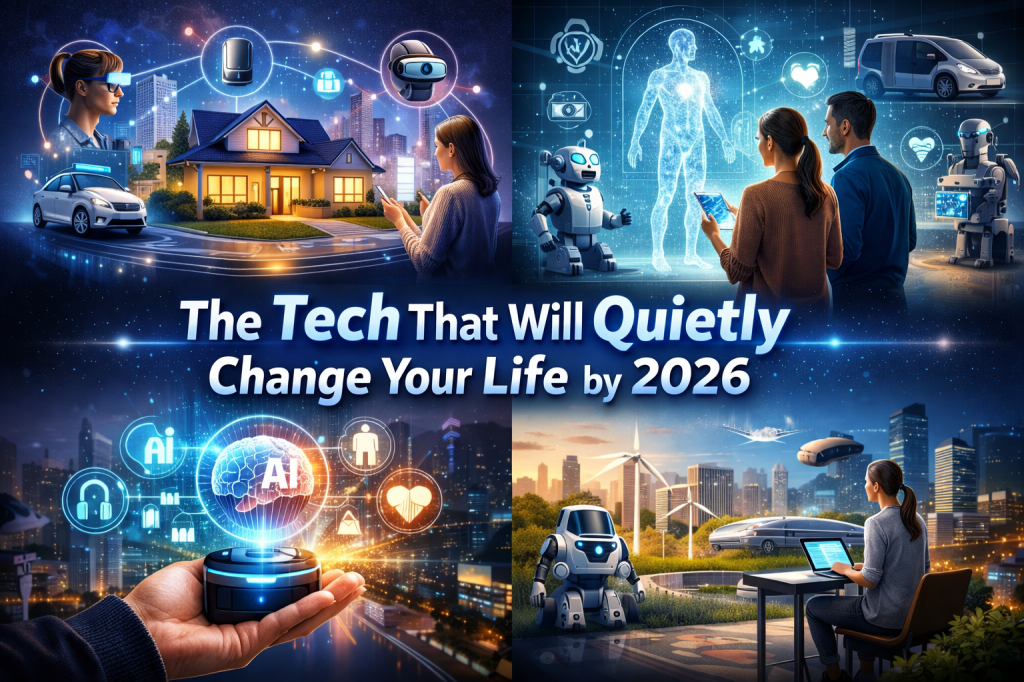
Most “future tech” articles shout about flying cars or robots taking jobs.
That’s not what’s actually happening.
The technology that will change your life by 2026 isn’t loud or dramatic. In many cases, you won’t even notice it at first. It will quietly sit in the background, nudging how we learn, work, create, and make decisions.
And that’s exactly why it matters.
Here are the shifts I’m paying close attention to – especially through the lens of education, families, and everyday life.
1. AI won’t replace teachers – but it will sit beside them
Generative AI in schools is no longer theoretical. The conversation has already moved past “should we ban it?” and into “how do we use this properly?”
What’s changing is the role AI plays.
Instead of doing the thinking for students, the best uses of AI act like a support layer:
- helping teachers plan lessons faster
- giving students feedback loops they never had before
- offering personalised explanations when a teacher can’t be everywhere at once
The most important shift isn’t the tech itself. It’s the mindset.
AI works best in learning environments when it augments human thinking, not replaces it. Used well, it creates more space for critical thinking, creativity, and actual teaching – not less.
By 2026, schools that treat AI as a learning tool rather than a shortcut will be miles ahead.
2. AI co-pilots will become normal at work
Right now, using AI at work still feels optional.
That won’t last.
By 2026, most knowledge workers will have some form of AI co-pilot built directly into the tools they already use – email, documents, spreadsheets, project systems.
Not as a robot boss. More like:
- a fast first draft
- a second brain for admin
- a way to clear mental clutter
The real benefit isn’t speed. It’s cognitive space.
When AI takes care of the repetitive stuff, humans get to spend more time on judgement, context, and decision-making. The jobs that thrive won’t be the ones that avoid AI – they’ll be the ones that know how to work alongside it.
3. Technology will become more invisible, not more obvious
One of the biggest shifts coming isn’t more screens.
It’s fewer.
This is often called ambient computing – technology that fades into the background and just works. Think:
- homes that adjust without you asking
- systems that anticipate needs instead of reacting
- infrastructure that prevents problems before you see them
When done well, it feels less like “using tech” and more like living in a well-designed environment.
The danger is obvious too. When tech becomes invisible, trust matters more than ever. Privacy, transparency, and control stop being optional extras – they become essential.
4. Creativity won’t disappear – it’ll become more human
Generative AI can already write, design, and create at scale. That scares a lot of people.
But here’s the counter-intuitive part.
As AI gets better at producing average content, human creativity becomes more valuable, not less.
Original thinking, taste, lived experience, and judgement are harder to automate than execution. AI is great at generating options. Humans are still responsible for choosing what matters.
By 2026, the most valuable creatives won’t be the fastest producers. They’ll be the best editors, curators, and thinkers.
5. Biotech will quietly outperform most headlines
While AI grabs attention, biotech is making some of the most meaningful changes to human life.
Gene therapies that once sounded impossible are now real treatments. Preventative medicine is becoming longer-lasting and easier to access. AI-assisted drug discovery is shrinking timelines that used to take decades.
You might not notice this day to day – until it affects someone you love.
This is one of those areas where “future tech” stops being abstract and becomes deeply personal.
6. The real differentiator will be trust
Every one of these technologies runs on data.
And the biggest question we haven’t fully answered yet is simple:
Who controls it, and who benefits?
By 2026, the organisations and systems people trust will win. Not because they’re the most advanced, but because they’re the most transparent, ethical, and human-centred.
In schools, workplaces, and public systems, responsible use won’t be a bonus. It’ll be the baseline.
The future isn’t arriving as a single big moment.
It’s arriving quietly, in small design decisions, policy choices, and everyday habits.
The question isn’t whether these technologies will shape our lives – they will.
The real question is whether we shape them intentionally or let them shape us by default.
 TrailCurrentTech
Leave a comment